



Quick context if you’re new here. An Unbothered Business Blueprint is the operating manual I created for how you, specifically, are built to run your business. It pulls from your Human Design, your chart, and the plain facts of how you actually think, lead, and make decisions, then turns all of that into a structure you can build on. The goal is a business that runs on your wiring, so the outside noise stops setting your pace.
Blueprint Field Notes is the diary side of that work. Each entry is a real week from my own business, where I show the blueprint doing its job in real time. You get the behind-the-scenes, the messy decisions, and the moves you can borrow for your own company. Last week was a maintenance week, so let’s get into it.
How to tell a commitment is fighting your blueprint

The first decision: I stopped writing the horoscopes.
It sounds small. It was one of the bigger shifts of my year. I had them pinned to the sky, a new piece for every new moon, every full moon, and every change of zodiac season. So several times a month, the calendar handed me a deadline. The moon would shift and a clock would start, whether or not the urge to write had arrived.
Here is the part I sat with for a long time. I am a manifestor. I am built to initiate in bursts, on my own timing, when the energy to create actually rises. A standing schedule pinned to the moon asked me to perform on a clock, which is one of the surest ways to smother a manifestor’s fire. More often than not, it would come time to write a post and I would dread it. I would resist and then make myself do it. That’s not the energy I’m here for.
The cadence was serving an old idea I had about what a consistent creator who works with astrology is supposed to do. So I let it go. The astrology still matters to me. I integrate it in everything I do. The format was the thing pulling against me.
That is what a blueprint is for. It is a set of decisions about how you specifically are meant to work, so you can stop renegotiating the same things every week. When a commitment fights your blueprint, you feel it. It drags.
You have a version of the horoscope. It’s the standing commitment you took on because it looked like what a serious business is supposed to do, and it quietly costs you something every time it comes due. Your blueprint gives you one clean question to hold it up against: does this run with how I work, or against it. The drag is your answer.
👉 If a commitment pulls on you every time it comes due, that is information about your wiring, not a verdict on your discipline.
Build one place where you can see your whole business
The bigger project last week was building a single place where I can actually see my business.
For years my numbers lived in seven different tools. Revenue in one place, the email list in another, Substack free and paid somewhere else, Instagram in its own app, speaking gigs in my head. My client pipeline lived half in a doc and half in my memory, which is a generous word for it. To answer a simple question like “how am I actually doing this month,” I had to go on a scavenger hunt, and the hunt was annoying enough that I mostly just skipped it.
So I built a command center. One screen, pulling live: revenue against goal, Instagram, Substack total and paid, the email list, speaking gigs. The client pipeline grouped by stage, so I can see what’s a lead, what’s waiting on me, and what’s actually moving. And my active tasks sorted by project, so the summit, the chapters work, and the roadmap stay in their own lanes instead of fighting for the same corner of my brain.
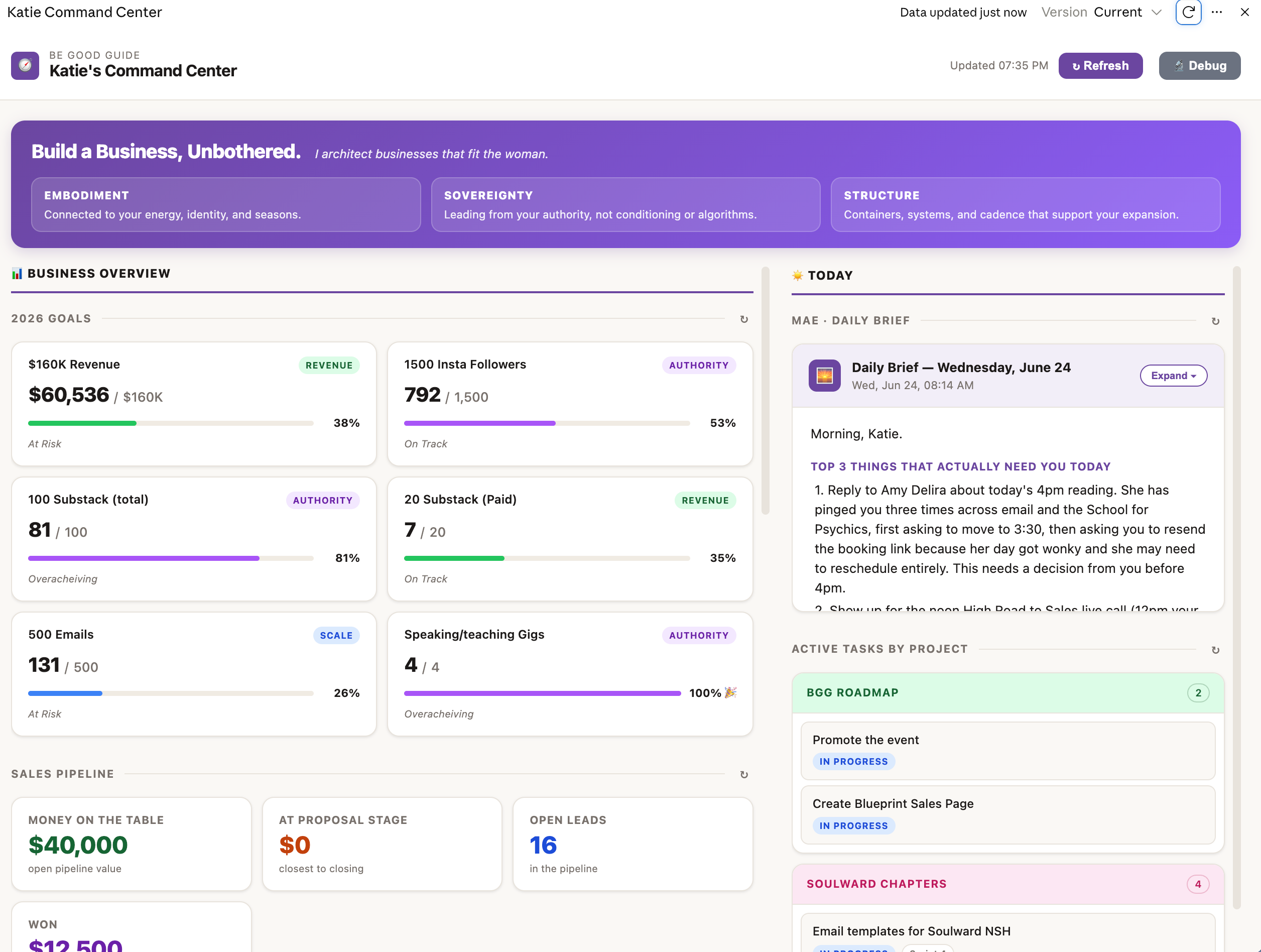
The strange thing about seeing it all in one place is how much calmer it made me. The calm came from setting the whole picture down, the way you set down a heavy bag. Some of those numbers still have a long way to go.
One of my favorite parts is the weekly view that looks at my calendar and tells me when open blocks are. It takes into account my Flow Formula™️ which uses my chart to tell me how to best utilize the days of the week. It also gives me a slap on the wrist in my daily brief if I’m working against it.

The dashboard holds the picture now, so my head is free to think instead of remember. That freedom matters extra for a manifestor. I move when the urge to start something rises, and a scattered, invisible business buries that urge under admin. One clear view hands the initiating energy back to me.
Your dashboard can look like anything. What matters is one surface where your real numbers and your real pipeline live together, so your mind gets to be a brain instead of a filing cabinet. The relief is less about the metrics and more about finally setting the weight down. You make better calls when you can see the whole board.
👉 When your business lives in one place you can see, your head is freed to run it instead of store it.
Being ahead can scatter you as much as being behind
Here is the moment from the week that stuck with me.
I’m building Client T a version of the same command center, along with many other systems, because she needs that CEO-level view into her own world the way I did. We got on our check-in, and she described feeling scattered. She was ahead on her monthly goals, with extra energy and nowhere to put it, so it was just sloshing around, making her feel busy and unfocused at the same time.
I know that feeling so well. Most capable people do. We talk about overwhelm like it only shows up when you’re behind, but some of the most disorienting weeks are the ones where you’re ahead and the surplus has nowhere to go. The energy stays. It scatters. It finds ten half-projects to leak into. And then you end the week tired, with the reason just out of reach.
That is a structure problem. When you can see your goals and your capacity in one place, the extra energy gets a destination. You can pull a future sprint forward, or you can rest on purpose. Both are good calls. So we’re building sprint planning around the goals next, for both of us, so the surplus has somewhere to land.
If you’ve ever closed out a strong week feeling oddly frayed, this is probably why. Capacity from being ahead needs a plan as much as the pressure of being behind does. Give it one on purpose, and your good week keeps its shape instead of dissolving into busywork.
👉 Extra capacity wants a destination too. Decide where it goes before it scatters on its own.
The real lesson: build around the operator, not the idea
The through-line in all of it, the horoscope, the dashboard, the conversation with Client T, is the same. A business should be built around how the person actually operates. Not how you assumed it should look when you started. Not the cadence someone else swears by. You.
Aligning the business to the operator is maintenance, the ongoing kind. Last week was a maintenance week. I dropped a thing that dragged, I built a thing that fit, and I helped someone I trust start doing the same.
Your maintenance week is waiting in the things that quietly drag, the numbers you can’t see in one place, and the energy that keeps scattering. You can run the same three moves on your own business this week: cut one commitment that fights your wiring, build one view that shows you the whole picture, and give your spare capacity a place to go.
That is the work. More field notes soon.

