



I have written more mission statements than I can count.
Corporate America.
Side hustles.
Startups.
Rebrands.
Every time I started something new, I followed the same business plan rubric like it was gospel: executive summary, market analysis, competitive landscape, mission statement, vision statement. I knew the formula. I could fill in the blanks in my sleep.
And every single time, I wanted to pull my hair out. The effort it takes to clarify and compile into that type of document is not small. It’s a huge hurdle and then, in my eyes, equally as big of a let-down.
Not because it was wrong.
Not because it wasn’t strategic.
But because it didn’t feel alive.
I would write one, feel vaguely uninspired, tweak it, rewrite it, polish it, then either:
Change it again six months later (ever keep rewriting your mission statement and business vision only to never share it with anyone? 🙋♀️)
Never look at it again
And if I’m honest, I was rewriting it because I was changing. My work was expanding. My interests were deepening. My leadership was evolving.
The document wasn’t wrong. It just wasn’t built for someone like me.
And it probably isn’t built for someone like you either.
Mission & Vision Were Built for Static Companies

Mission statements explain what a company does and how it operates right now. Vision statements describe where it’s going and what it hopes to achieve long term. They’re useful tools inside organizations that need alignment across departments and predictable trajectories.
Lets break this down a bit more, shall we?


A mission statement explains:
What the company does
Who it serves
How it operates right now
It’s functional. It’s operational. It’s meant to describe current activity. It’s usually vague. Mission statements are excellent for organizations that need consistency and alignment across large teams.
Nike: To bring inspiration and innovation to every athlete* in the world. *If you have a body, you are an athlete.


A vision statement describes:
Where the company is going
What it hopes to achieve long-term
It’s future-oriented. It’s aspirational.
But it’s still directional in a linear way. Vision statements assume a fairly predictable trajectory.
Coca-Cola: Our vision is to craft the brands and choice of drinks that people love, to refresh them in body & spirit. And done in ways that create a more sustainable business and better shared future that makes a difference in people’s lives, communities and our planet.
They assume stability.
They assume structure.
They assume that the “company” exists independently from the human leading it.
But when you are the business, the brand, and the strategy, when your work evolves as you evolve, that model starts to break.
Because you’re not building a static company.
You’re building a living ecosystem.
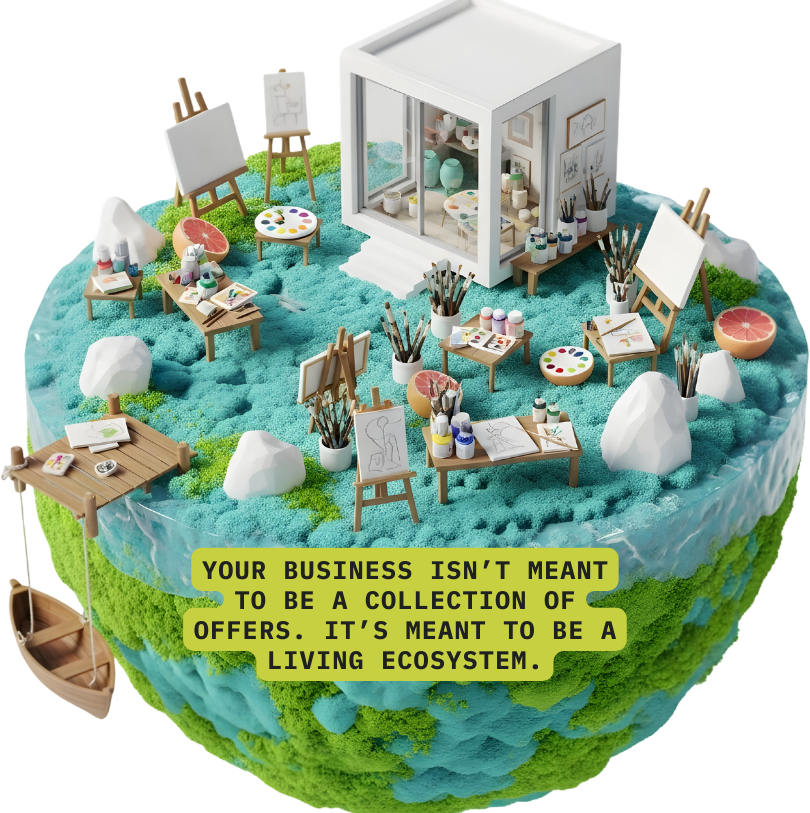
And ecosystems don’t operate in five-year linear projections. They grow, expand, contract, regenerate. They respond to seasons. They adapt to new inputs. They reorganize when something new wants to emerge.
Every time I tried to force my work into a mission statement, it felt like I was trying to pin a butterfly to a corkboard.
Technically accurate. Completely lifeless.
The most frustrating part is that you DO need clarity before starting a business. While you can build a business willy-nilly, it’s certainly going to be harder, slower and most likely cost you a lot more.
The Question That Changed Everything

So whats a girly to do? If you’re someone who creates magic across multiple disciplines it can be so easy to default to just listing all the things you DO instead of what your business is actually meant to impact. Here was my turning point:
Instead of asking,
“What is my mission?”
I started asking,
“What is the shift I am here to create?”
Not what I sell.
Not what platform I use.
Not what my current offer suite looks like.
But what changes because I exist.
That’s where movement statements were born.
A movement statement doesn’t describe your services. It names your stand. It articulates what you believe needs to change and the larger shift your work contributes to. It’s less about what you do and more about what becomes possible when you do it.


A movement statement articulates:
What you believe needs to change
What you’re here to disrupt or restore
The larger shift your work contributes to
It’s not about what you do. It’s about what changes because you exist.
Think of this like a rally cry behind what you do that is designed to connect with people who resonate with it. I took the liberty of writing some for the two companies I referenced above to show how it FEELS different.
Nike Movement Statement (hypothetical): Human potential isn’t reserved for the elite. Movement belongs to everyone, and the world changes when people reclaim their bodies as powerful, capable, and alive.
Coca-Cola Movement Statement (hypothetical): Life is meant to be shared. In a fragmented world, small moments of connection matter and joy multiplies when people come together.
After doing some thinking around the driving force behind my work, I kept coming back to my core belief:
Women are not meant to contort themselves to systems, formulas, or methods that were never built to hold them.
And when I distilled it even further into a rally cry for that message, I landed on:
Alignment over algorithm.
That single line does more work than any mission statement I ever wrote. It holds my offers. It holds my content. It holds my pacing. It even holds the way I build tech systems.
Because it’s not a description. It’s a declaration.
Why This Matters Now: The Evolution of Business

What I didn’t fully understand at the time was that this wasn’t just about my personal frustration with corporate language.
It was about capacity.
Mission and vision statements are mechanisms built for stability. They’re designed to preserve structure. To protect consistency. To optimize predictability.
But if you are building something that evolves with you, you need mechanisms that move.
You need a spine that can hold expansion.
You need language that adapts without collapsing.
You need a framework that supports change instead of resisting it.
And this isn’t just a preference anymore. It’s becoming a necessity. Because we are entering a completely different era of business that’s being shaped by the astrological climate of this pivotal year.
We’re Entering a Different Era of Trust

Neptune and Saturn have moved into Aries. Uranus is in Gemini. If you caught my Astrology of 2026 breakdown*, you know what I’ve been saying: we are renegotiating trust in a world mediated by AI.
*and if you missed the webinar and want the replay, drop a comment.
We’re already feeling it.
You land on a website and wonder:
Is this real?
Is this a real person?
Is this product going to show up at full size or am I getting the miniature Amazon version?
We’re moving from brand-centric trust to human-centric trust.
In a hyper-automated world, people are craving conviction. They want to feel the person behind the company. They want to know what you stand for. They want emotional coherence.
Mission statements don’t create that. Movements do. Because movements are rooted in belief. And belief is human.
Emotional Connection Is the Differentiator Now

In a crowded market where everyone has access to the same tools, the same AI copy assistants, the same funnel templates, differentiation is no longer about polish.
It’s about clarity of conviction.
When someone encounters your movement statement, they shouldn’t think, “Oh, that’s a well-positioned brand.”
They should feel, “Finally. Someone said it.”
That’s what creates loyalty. That’s what creates resonance. That’s what makes someone choose you even when there are technically cheaper or more optimized options available.
People don’t rally around services. They rally around shifts.
Movement Is Collective. Sovereignty Is Personal.

This is where most people stop, but I don’t.
Because naming your movement without claiming your sovereignty is a fast track to burnout.
Your movement statement defines the shift you are participating in.
Your sovereignty statement defines how you operate inside that shift.
It answers questions like:
What am I no longer willing to tolerate in my industry?
What pace protects my nervous system?
What am I unwilling to do for growth?
What does success look like on my terms?
For me, sovereignty sounds like:
I don’t build followers. I build leaders.
Business models are architected for the woman.
Urgency is not my marketing plan.
Rest is part of my strategy.
I will not contort for access.
Movement gives your work direction. Sovereignty protects your energy while you carry it.
From Static Plan to Living Ecosystem

When you root your business in a movement instead of a mission statement, something subtle but powerful happens.
Your offers stop feeling random. They become expressions of the same belief.
Your platforms stop feeling scattered. They become delivery systems for the same shift.
Your pivots stop feeling like identity crises. They become natural expansions of the ecosystem.
Your movement stays consistent. Your creation and delivery evolve and compound.
That’s the difference.
If You’re Feeling Scattered, Read This Slowly

You are not too multi-passionate.
You are not bad at branding.
You are not incapable of clarity.
You are trying to compress a movement into a mission statement.
We are entering an era where trust is human, leadership is embodied, and conviction beats optimization. In that world, static corporate language will not carry you.
Belief will.
Name the shift.
Claim your sovereignty.
And let your business organize itself around something that’s actually alive.
—
If this stirred something in you, I’m curious:
What are you no longer willing to tolerate in your industry?
That’s usually where the movement begins.
