



I was sitting around a bonfire after Soulward Summit (a conference I co-hosted) surrounded by women I trust, when I said something out loud that I think I’m still learning how to live with:
I’m the villain in a lot of people’s stories.
Not because I’ve never gotten it wrong. I have. There are friendships and relationships where I can look back and say, yeah, I could’ve handled that differently. I’m not interested in pretending I’ve moved through life without impact. I care deeply about how I affect people. Sometimes, probably to a fault.
I’m the kind of person who, if I’m driving and my friend in the passenger seat has a wonky back, I’ll literally make sure the tires on my side of the car go over the speed bump instead of hers.
That is how I move through relationships.
I am thinking about your comfort.
Your bandwidth.
Your feelings.
Your context.
The invisible thing you’re carrying that maybe no one else would notice.
And I think that’s why this particular kind of grief has been so hard to name.
Because underneath all of the conflict, the projection, the misunderstandings, the “I never meant it that way” conversations, the thing that hurts most is actually very simple:
I am deeply considerate. And I do not feel deeply considered.
That’s the wound.
And lately, it’s been impossible to ignore.

Over the last few weeks, I’ve found myself tracing a pattern that honestly stretches back years.
Different people.
Different circumstances.
Same ache.
A friend sends something inflammatory to someone close to me, gets called out, and instead of taking it up with the person who set the boundary, routes the whole thing through me → during one of the biggest, most important weekends of my life.
Another friend, someone I thought was one of my closest people, can’t seem to answer a simple logistical question I’ve been asking for over a week about whether she has the capacity to show up for something that matters deeply to me. I gave her an out. I made room. I made it easy. “If you don’t have the bandwidth, that’s okay. I just need to know.” And instead of a clear answer, I got delay, ambiguity, emotional flooding, and a whole lot of context in place of clarity.
And then there are the older stories.
The friendships where I could feel something had shifted, but no one said anything. So I was the one who opened the door. I was the one who said, Hey, if something’s off, let’s talk about it. Only to find out they had apparently been hurt by me for months or years…and by the time they finally brought it to me…
They weren’t asking for repair.
They were presenting a case.
That part is brutal.
Because when someone has been privately building a story about you for long enough, your actual intentions and sometimes even your actual behavior become almost irrelevant.
You’re no longer in a conversation.
You’re in a courtroom.
And I think that’s why some of these dynamics have felt so impossible to heal.
Not because I wasn’t willing, but because by the time I got there, I wasn’t being met as a person anymore.
I was being met as a symbol.

That’s the part I’ve been trying to understand.
Because I don’t actually think I’ve been the villain in all of these stories.
But I do think I’ve often been the mirror.
And there’s a difference.
A mirror doesn’t create what’s there.
It reflects it back.
I’m starting to realize that in some relationships, what people were reacting to wasn’t necessarily me. It was what got stirred up in them around me.
Their insecurity.
Their resentment.
Their unspoken expectations.
Their disappointment.
Their fear of not being chosen.
Their discomfort with my boundaries.
Their discomfort with my capacity changing.
That last one has hit especially hard.
Because when I zoom out, one of the clearest patterns I can see is this:
People are often very comfortable receiving my capacity. They struggle when that capacity changes.
And that has been one of the most painful things to admit.
Because I have been a person with a lot of capacity.
I’m the one who checks in.
The one who organizes.
The one who remembers.
The one who follows up.
The one who notices when something’s off.
The one who makes the plan, builds the room, carries the emotional context, softens the edges, keeps things moving.
I know how to hold a lot.
But the older I get, the more I’m realizing that some people didn’t actually know how to relate to me.
They knew how to relate to what I provided.
And the moment I stopped over-functioning because I was under-resourced, heartbroken, burned out, leading something big, or simply trying to choose myself for once, the relationship got exposed.
That’s not an easy thing to say out loud. But it’s true.

There was a season of my life, after I was laid off from Twitter, in the uncertainty of my new direction but certain of what I didn’t want to continue, when I was not okay. There were so many unknowns (financially, emotionally, etc) but that’s a story for a different day.
I was depleted in a way that changed my availability. Not in a dramatic, “I’m disappearing and ghosting everyone” way. In a very adult, very human way. I was honest about it. I said, I don’t have the same capacity right now.
And what I learned in that season was heartbreaking.
Because some people who I had shown up for through divorces, miscarriages, breakdowns, spirals, life implosions, all of it…did not know how to stay in relationship with me when I was no longer able to provide that same level of access and emotional labor back.
They didn’t say, “Hey, I miss you. This feels different. I’m having a hard time with the shift.”
Instead, I became “cold”. Distant. Different. The problem.
That’s what I mean when I say I think I’ve been miscast.
Not always misunderstood.
Miscast.
There’s a difference between someone not fully getting you and someone assigning you a role in their story that has very little to do with who you actually are.
And if you’ve ever experienced that, you know how disorienting it can be.
Because it makes you question everything.
Was I selfish?
Was I too blunt?
Was I not supportive enough?
Was I too much?
Was I too unavailable?
Too focused on myself?
Too harsh for naming what was true?
I have spent years trying to answer those questions responsibly.
Not performatively. But genuinely.
I’ve been in the “I’m the common denominator, so I must be the problem” spiral.
I have spent more money on therapy around friendship wounds than I’d care to admit. I’ve done conflict work. Communication work. Attachment work. Nervous system work. Repair work. I have tried, over and over again, to become a safer, clearer, more emotionally responsible person to be in relationship with.
And while that work has mattered deeply, here’s what I’m also realizing:
No amount of self-work can protect you from being miscast by people who rely on your over-functioning.
There are some dynamics where no amount of your insight, accountability, softness, or skill will ever be enough. The role you’re being asked to play was never actually about truth.
It was about comfort.
Access.
Control.
Convenience.
A version of you that was easier to consume. And when you stop being that version, people who benefited from it don’t always know what to do.

I also want to say something that feels important here.
I know enough about myself to understand that I naturally hold a bit of a projection field (5/1 Manifestor 🙋♀️). People often don’t just relate to who I am. They relate to what they assume, expect, fear, need, or assign onto me. That’s real. I could write a whole separate piece about that and I will.
But what I’m more interested in here is what it feels like to live inside that dynamic in actual relationships.
To be someone who is often experienced as “strong” and still feel profoundly unsupported.
To be the one who sees everyone’s context and still feel like no one can clock the moment you’re in.
To be hosting one of the biggest events of your life and find yourself fielding emotional shrapnel from people who, if the roles were reversed, you would have gone out of your way not to burden.
To make room.
To make it easy.
To make the path clear.
And still be met with fog.
That’s the part I think a lot of us don’t talk about.
Because it’s one thing to say, I’ve been hurt.
It’s another thing to admit:
I’m grieving the realization that some of the people closest to me could not rise to the moments that mattered to me.
That’s what has been cracking something open in me.
Not just the conflict itself.
The timing.
The attunement.
The lack of regard.
Because when you are someone who is constantly accounting for other people’s context, it hurts in a very specific way when they cannot seem to account for yours.
It’s not just what happened.
It’s when it happened.
And that reveals more than I think we want to admit.

What made this impossible to ignore wasn’t just the pattern.
It was the contrast.
I got one of those texts during the conference (15 min after getting off stage to kick off the whole thing), while I was literally in a room I had built, surrounded by 40 women (and one supportive king) who saw me clearly, who weren’t projecting onto me, who weren’t asking me to distort myself to be digestible.
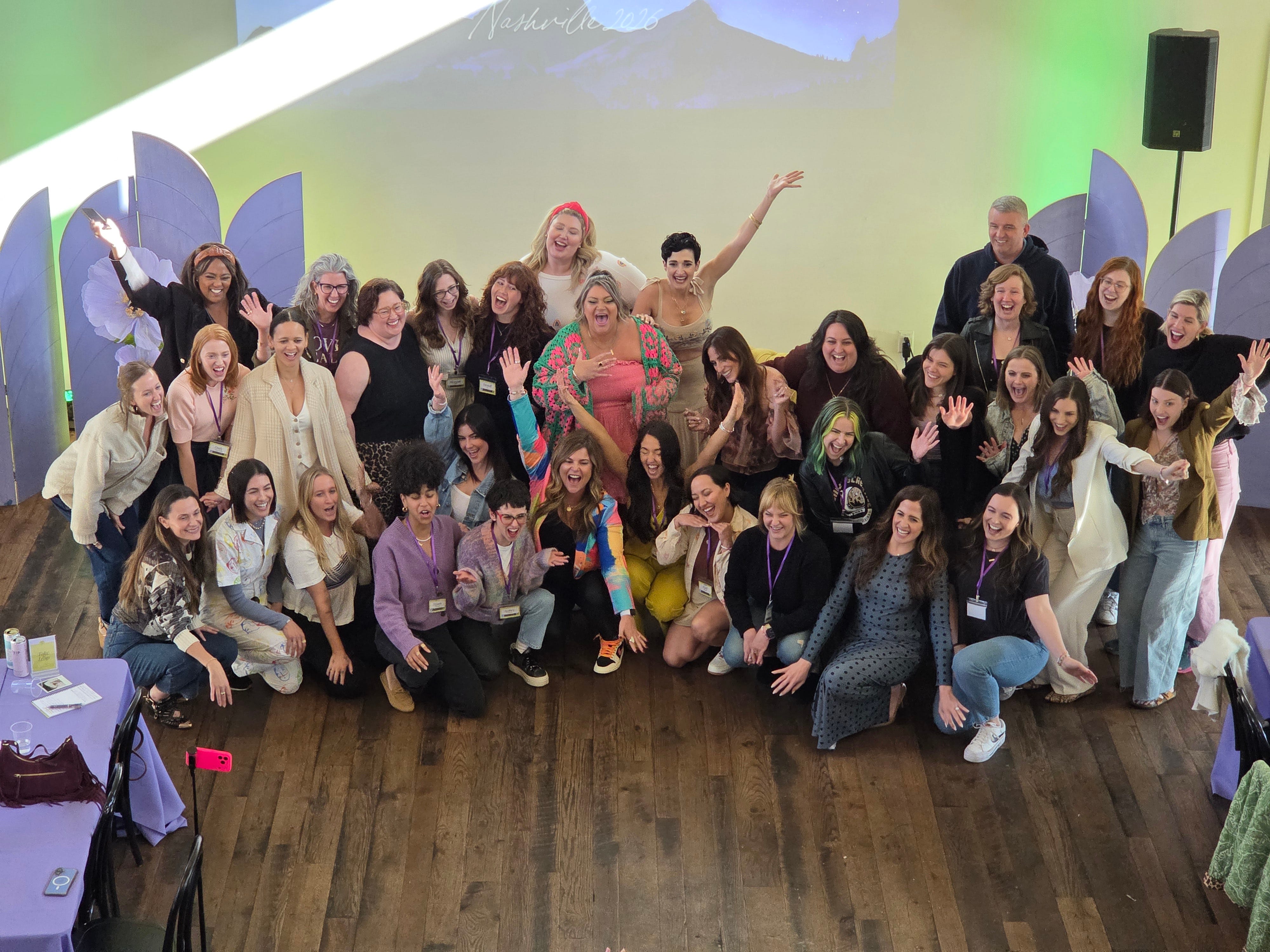
And I remember looking up from my phone, taking it all in, and realizing something I don’t think I could’ve seen as clearly anywhere else:
I am not too much. I am just no longer available for relationships that require me to become less myself in order to maintain them.
That same day, the speaker on stage asked:
Where is your energy leaking? What are you ready to release?
And without overthinking it, I wrote down:
“Maintaining relationships at all costs.”
That’s what I’ve been doing.
Holding on.
Explaining.
Bridging.
Softening.
Trying to preserve connection even after something essential had already left the room.
And being in a space where I didn’t have to do that, where I was seen clearly without effort, made it impossible to keep negotiating with relationships that required me to.

And if there’s one thing I’m walking away from Soulward Summit with, it’s this:
There are rooms where you do not have to earn your belonging by over-functioning.
There are rooms where your muchness is not a problem to solve.
Where your sensitivity is not a burden.
Where your truth doesn’t need to be diluted to be received.
Where your presence is not just tolerated, but deeply welcomed.
And maybe that’s the real grief in all of this.
Not just seeing what no longer fits.
But finally experiencing what does.
Because once you’ve been in a room where you feel:
seen,
heard,
held,
expanded,
and met…
it becomes a lot harder to keep bargaining with relationships that require self-abandonment to maintain.
That’s the power of community.
Not just being surrounded by people.
But being surrounded by the right people.
People with heart.
People with capacity.
People who can celebrate you without resenting you.
People who can meet your humanity without projecting onto it.
People who don’t need you to become smaller in order to stay connected.
That’s the kind of room I want to keep building.
Not just for myself.
But for the women who have spent years wondering if they are too much, too intense, too honest, too sensitive, too hard to hold.
You’re not.
You may have just been trying to bloom in places that could only tolerate your pruning.

“…it makes you question everything.
Was I selfish?
Was I too blunt?
Was I not supportive enough?
Was I too much?
Was I too unavailable?
Too focused on myself?
Too harsh for naming what was true?”
Shewwwwww. I feel this!