



There are seasons of life where everything feels like it’s being pulled into sharper contrast.
That’s what this season feels like for me.
Maybe it’s the Saturn-Neptune tension in the air right now. The push-pull between structure and fog. What’s real and what’s imagined. What’s solid and what’s dissolving. But lately, I’ve been feeling the shifts in my body before I can even fully name them with words.
At Soulward Summit, I found myself in the middle of an activation called Therapaint, processing an emotion I didn’t realize I was still carrying so viscerally: the clawing feeling of being projected onto.
Not just misunderstood. Not just unseen. But that deeper, more invasive feeling of being grabbed at energetically. Interpreted. Pulled on. Reduced into someone else’s version of who you are.
We were outside on the lawn, splattering paint against paper, moving emotion through the body. And at some point, I stopped painting.
I dropped to my knees.
And I started clawing at the paper.
Hard enough that my press-on nails tore through the gloves I was wearing. You could see the marks in the paper after. The physical evidence of something I had clearly been carrying for a long time.
And as intense as that moment was, what struck me most was what happened after.
Because the very next day, I was in a completely different kind of room.
A VIP integration day where I felt deeply held. Witnessed. Received. I was gifted a card that said:
What I want, I can achieve.
And it hit me that this is what life has been showing me lately in such an undeniable way: the contrast between rooms that hook you and rooms that hold you.
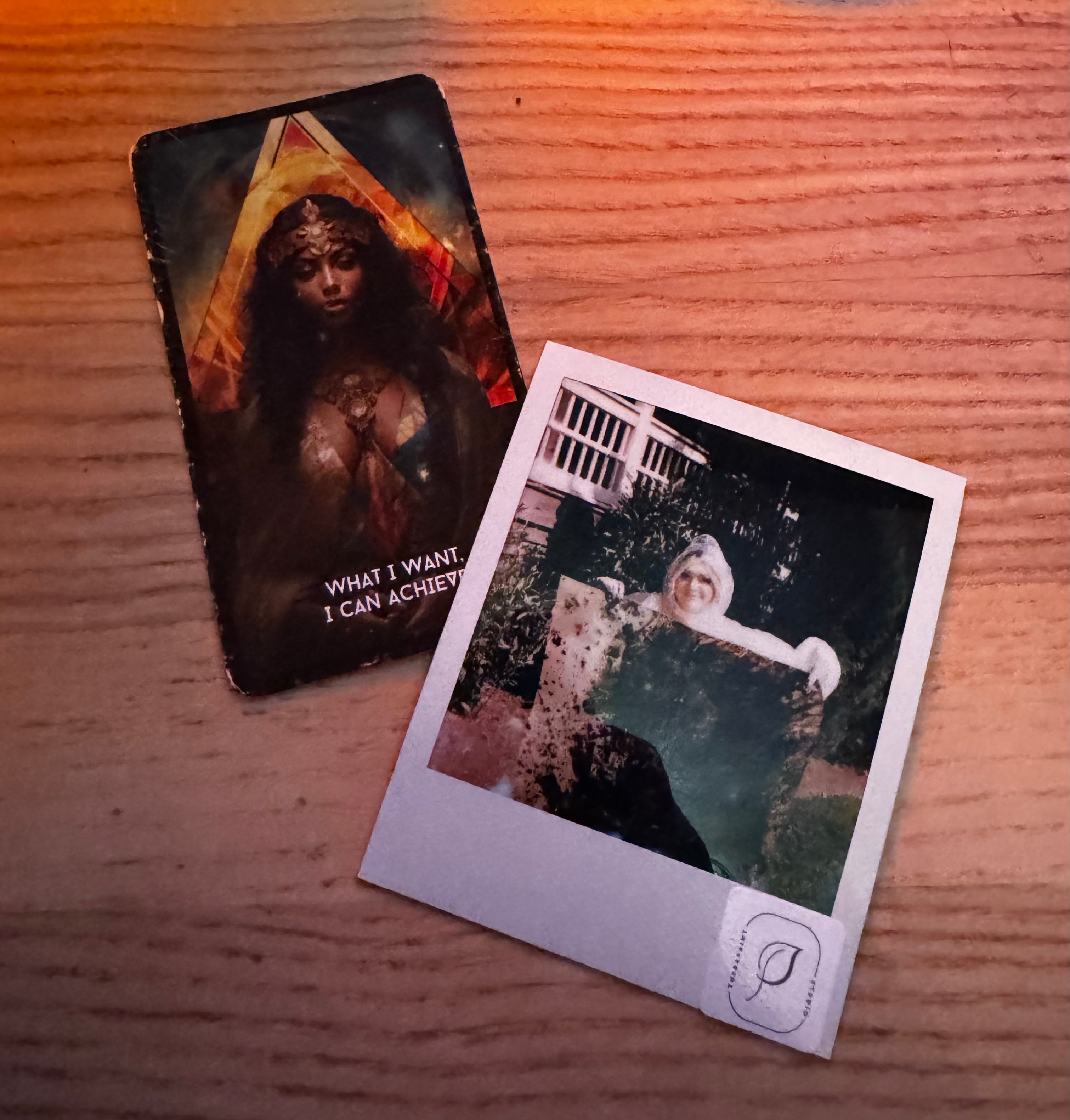
The difference between being projected onto and being fully witnessed.
And once you feel that contrast in your body, it becomes almost impossible to ignore.
The world is showing me contrast right now. Deep contrast. Between the rooms where I feel projected onto and the rooms where I feel deeply seen and held.
And honestly, I think this is one of the clearest ways I’ve ever understood what visibility actually asks of us.
Because for a long time, I thought the goal was simply to be seen. But being seen is not the same thing as being met.
To be truly seen is to be witnessed. To be heard is to be received. But to be projected onto is to become a screen for someone else’s fear, assumptions, discomfort, insecurity, and need to categorize what they don’t fully understand.
And when you’ve spent a lot of your life feeling unworthy of being fully considered, that distinction matters. A lot.
Some rooms hold you. Some rooms hook you.

There are rooms where people are with you. Where you feel safe, honest, received, and held in your full humanity.
And then there are rooms where you can feel the energy trying to grab onto you. Interpret you. Reduce you. Place you. Pull meaning out of you that was never yours to carry.
That’s the energy I’ve been thinking about lately.
The clawing energy of projection.
And once you’ve felt the difference in your body, it becomes very hard to unsee.
What’s been shifting

Recently, I’ve been doing some deeper release work (hello Cord Cutting with Marguerite! Casa Della Madre ) around smallness and around a very specific wound:
the feeling of being unworthy of being considered.
Not just misunderstood. Not just overlooked.
But the deeper, subtler feeling of people deciding who you are, what you mean, or how they want to hold you without actually taking the time to meet you.
That’s a very particular kind of pain.
And when you start releasing it, something changes. You become much more sensitive to the difference between being witnessed and being projected onto.
You notice which spaces feel spacious. Which ones feel grabby. Which ones feel like truth. And which ones feel like someone trying to fit you into a script they already wrote.
That’s what’s been getting louder for me lately.
Soulward Summit gave me a body-level reference point

One of the clearest examples of this for me has been Soulward Summit. Not just the event itself, though that was absolutely the highest and biggest expression of it. But everything that kept living after it.
The voice memo conversations across time zones that somehow already carry more depth than some connections I’ve had for years. The side texts. The group chats.
The names of the chats alone telling on the energy: HOT GIRL FNDRS 🔥💖. Super Yacht WhatsApp.
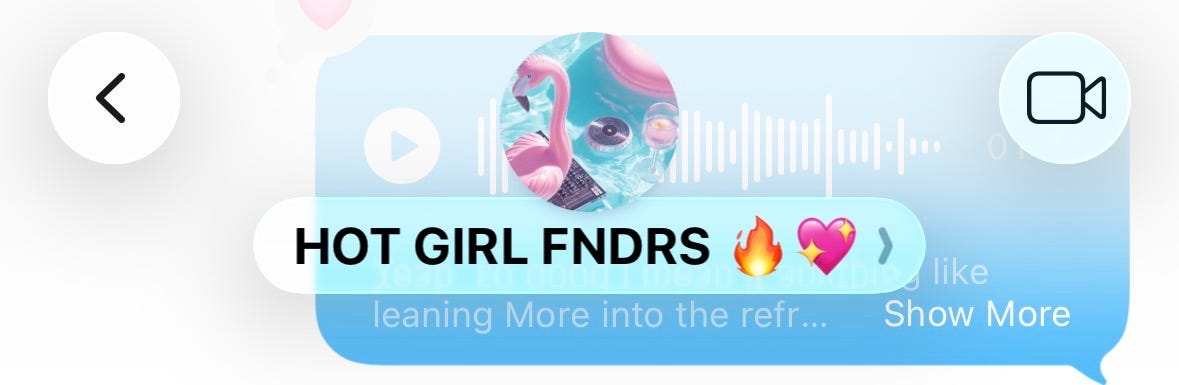

You can tell a lot about a room by what people feel safe enough to name inside it. That matters to me. Because those spaces don’t just feel “safe” in the way people often talk about safety online. They feel alive. They feel playful. Honest. Unforced. Like people actually getting to be themselves in real time.
No clawing. No flattening. No weird energetic undertow of projection.
Just resonance. Just chemistry. Just the kind of connection that keeps unfolding because something true was opened.
And once you feel that kind of room in your body, it becomes almost impossible to keep romanticizing the ones that only ever asked you to shrink.
That contrast has been hitting me hard lately.
Because once you remember what it feels like to be in rooms where people are genuinely with you, it becomes a lot harder to normalize spaces where people are just trying to make meaning out of you.
This has everything to do with visibility

Because here’s what I’m realizing:
A lot of women think they have a visibility problem. But often, what they actually have is a projection wound.
They’ve spent so long trying to protect themselves from being misunderstood, misread, flattened, or reduced that they unconsciously start shaping their expression around avoiding distortion.
And that changes everything. It changes how you write, how you sell, how you explain your work, and how much of yourself you allow people to actually encounter.
I felt this so deeply recently during a marketing masterclass inside Authentic Business Club.
There was a conversation around context. How much context does someone need to understand your work? How do you create a smaller freebie or offer that still “makes sense”? How do you help people access your work without the full backstory?
And I realized how much of my own history lives inside that question.
Because for so many years, I was trying to make my work make sense to people who were never actually entering it through resonance. I was trying to pre-explain myself into safety. Trying to translate something potent into something instantly digestible. Trying to remove any edge that might make someone misunderstand me. And in the process, I watered down what I was actually here to say.
The hidden cost of trying to be understood by everyone

There is absolutely a place for context.
But there is also a point where context stops being clarity and starts becoming self-protection.
That line is everything.
Because when you’re still trying to earn the right to be fully considered, you will over-explain, over-contextualize, over-soften, over-qualify, and over-package your truth until it loses its original charge.
Not because your work isn’t clear.
But because some part of you is still trying to create immunity from projection.
And that’s not possible.
Not in leadership. Not in visibility. Not in art. Not in business. At a certain point, your work has to be willing to stand on its own feet. Not because everyone will understand it immediately. But because it is true enough to hold.
The projection field

The more visible you become, the more you enter what I think of as the projection field.
This is the space where people stop simply receiving you and start filtering you through their assumptions, their discomfort, their insecurities, and their need to categorize what they don’t fully understand.
And if you don’t understand this, you will spend a lot of energy trying to become more “accurate” to people who were never actually seeing you clearly to begin with.
That’s where women start shrinking.
That’s where they start softening their voice, making their work more palatable, and editing out the parts that carry the deepest charge.
Projection can feel like danger if your body still associates being misunderstood with losing belonging.
A quick Human Design note, because it matters

In Human Design, the projection field has a more specific meaning.
It’s especially relevant for people with 2-line and 5-line profile, where others tend to see not just you, but what they imagine you are here to do for them.
If you carry 2-line energy, you may notice that people naturally “call out” gifts in you before you even feel fully ready to name them yourself.
That can be beautiful when it comes from the right people and the right timing.
But when it comes from the wrong rooms, it can feel like pressure, depletion, being pulled into roles you never consciously chose, or being seen for a talent without actually being met.
Sometimes what looks like recognition is just projection with good branding.
If you carry 5-line energy, this can feel even more intense. Because 5-line projection often comes with people seeing you as the answer, the fix, the disruptor, or the one who can save, solve, or restore order.
Which sounds powerful until you realize how often that means people are relating to a role instead of a real person.
That’s the trap. You become deeply visible, but not necessarily deeply known.
And that’s where discernment becomes everything.
And even if you don’t have a 2 or 5 line in your profile, I still think the broader conversation matters.
Because in practice, anyone who is highly visible, deeply expressive, naturally magnetic, or building something outside the usual script will encounter projection.
Especially trailblazers.
Especially women who are no longer willing to be legible only through other people’s comfort.
So what do you actually do with this?

If you’ve been reading this and recognizing yourself in it, the answer isn’t to try to eliminate projection.
You can’t.
Not if you want to be visible. Not if you want to lead. Not if you’re doing anything that exists outside of what’s already been approved or understood.
Projection is part of the terrain.
Especially if you are building something that doesn’t have a clear reference point, expressing yourself in a way that isn’t easily categorized, or moving in a way that challenges what people have been taught is “normal.”
In other words:
If you’re a trailblazer, you are going to be projected onto.
That doesn’t mean something has gone wrong.
It means you’ve stepped outside of the script.
1. Anchor back into your inherent value
Before anything else, this is the foundation:
You are not valuable because you are understood.
You are not worthy because you are correctly interpreted.
You are inherently valuable in who you are and in the magic you bring by existing as yourself.
Projection doesn’t change that. Misinterpretation doesn’t remove that. Someone else’s story about you doesn’t define that. If anything, this work is about returning to that baseline over and over again.
2. Learn to identify whether you’re being met or being cast
This is such an important distinction.
Ask yourself:
Do I feel nourished by this room, or depleted by it?
Am I being met, or am I being cast?
Is this recognition, or is this expectation?
Is this a space where I can stay whole, or one where I immediately start editing myself?
Because once you start asking better questions, you stop taking every energetic experience at face value. And that changes a lot.
3. Stop organizing your expression around avoiding projection
This is where so much of the energy leak happens. Trying to say it perfectly, explain it enough, soften it just right, or add enough context to prevent misunderstanding.
But what’s actually happening underneath that is this:
you’re trying to create safety through control of perception.
And that will dilute your work every time.
Instead, the shift is simple:
Let your work be clear.
Let it be true.
Let it carry its full charge.
And allow people to meet it from where they are.
Not everyone will.
And that’s okay.
4. Build and choose the right rooms
This is the part we don’t talk about enough. It’s not just about tolerating projection. It’s also about becoming more available for spaces where you are actually witnessed.
Where you don’t have to translate yourself constantly. Where you’re not being flattened into something more digestible. Where your nuance is allowed to exist. Where your presence is met, not managed. Those rooms exist.
And once you experience them, your standards change. You stop trying to be for every room. You start building and choosing the right ones.
Final reframe
A lot of what feels like a visibility problem is actually a threshold of self-trust.
Not:
Can I be seen?
But:
Can I remain rooted in who I am even when I am being interpreted?
Because once you can do that, projection stops being something you organize your life around. It becomes something you notice without collapsing for. And that’s when your work starts to land differently.
You stop trying to be for every room. You start building the ones that can actually hold you.
