


In January, my whole plan for the year lived in an Apple Note.
It was a giant outline of everything I wanted to bring into the world, across my own business and my clients’ businesses. Every morning I’d open it and pick whatever I felt called to work on that day. No outline of what it would actually take to bring any one thing into the world. No line connecting today’s task to a specific, tangible goal. Just a list, and a feeling, and me deciding in real time what earned my attention.

It worked, sort of. I got things done. But I couldn’t have told you which of those things actually moved the needle, because nothing was laddered up to anything. It’s like I forgot everything I learned in corporate america that works. Don’t worry, I remembered.
Six months later, I don’t have a task list. I have a roadmap. And the shift between the two is the thing I want to walk you through.
Where this actually comes from

Before Be Good Guide, I spent 23 years in tech and product, and a good chunk of that was inside the Agile process, which came out of engineering and eventually took over how a lot of the companies I worked at executed plans.
Agile is a philosophy more than a rigid method. It prioritizes people and collaboration over rigid tools, and responding to change over following a fixed plan set in January and defended through December.
In practice, that meant breaking down a big goal from the C-suite into short, defined cycles of work instead of trying to plan the whole thing up front. What I watched it do well, across multiple companies and multiple teams, was give leadership visibility into progress as a byproduct of the work itself, not as extra reporting bolted on top. And it wasn’t built around a deadline you worked backward from. It was built around continuous progress that laddered up to something bigger, at a pace that respected what the team could actually hold.
Here’s why that matters if you run your own business. In a company, that structure exists because there are departments. There’s a person for bringing in new business and a person for delivery and a person watching the roadmap. When you’re a solopreneur, you’re every one of those departments. Some days you’re in the weeds: sending emails, running client sessions, launching the thing. Other days you need to be above it, looking at where you’re actually headed.
Most entrepreneurs never built the structure that lets you move between those two modes on purpose. So you just stay in the weeds, because the weeds are loud and the roadmap is quiet.
The three layers: goal, milestone, task
This is the ladder I use now, and I think most people are missing the middle rung.
Goals need to be measurable, and I give mine a long runway. Mine are set for the full year, and I don’t revisit them until the following Q3. This let’s me focus on what I’ve committed to and then also gives me a quarter ahead to decide on the next years goals (yearly planning happens in the Q3 before). I also keep the number of goals small on purpose. I track a main revenue goal, a scale goal (email list and Substack subscribers, free and paid), an authority goal (things like podcast guesting or speaking), and an operations goal focused on what I’m optimizing or automating. That last one isn’t a quantity metric. It’s closer to done or not done. I also make sure to have 1-2 Joy goals for myself (take 2 trips, attend a retreat, etc). Those are what make the other goals worth it.
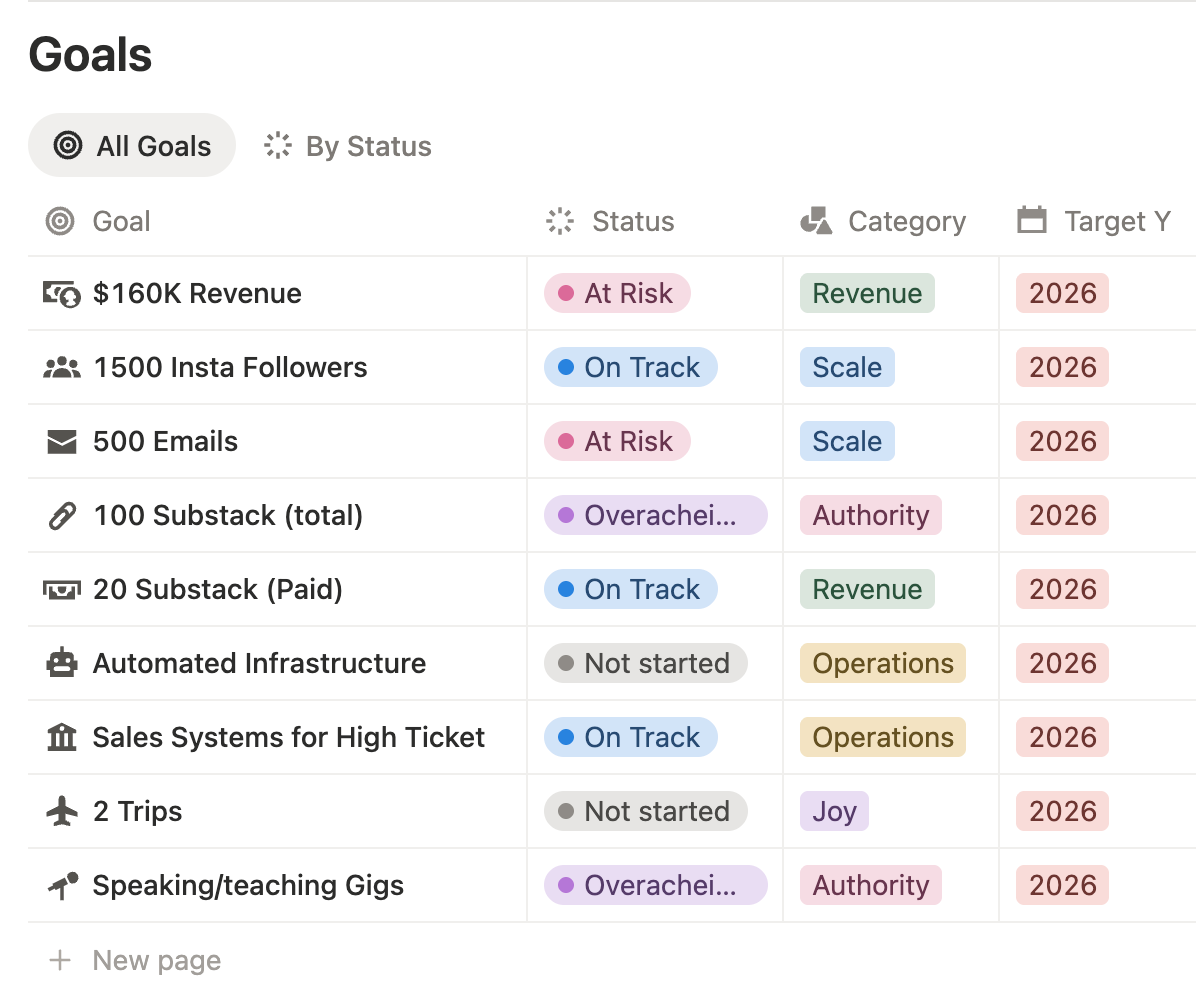
Milestones are what most people would call projects, and they’re the layer almost everyone skips straight past. If you’re sitting down and asking “what could I build,” you’re not yet asking how it ladders up to where you’re going. Say the goal is $30K. The milestone underneath it isn’t “launch something new.” It could just as easily be “land 10 clients on an existing service, from your existing audience.” That’s a milestone: specific, and completable.
Tasks are what it actually takes to hit the milestone. Under “land 10 clients on an existing service,” a task might be identifying which past clients are warm leads for that service again. Another task is drafting the email. Another is sending it. Nothing revolutionary on its own, but every task is now attached to something. That’s the whole shift. You stop piling on to-dos and start asking what each one is actually contributing to.
Running the retrospective before you build the roadmap
Before I help a client build their roadmap, we run a Stop, Start, Continue retro first. I did this with one of my monthly advisory clients two weeks ago, using a template I already had built in Canva, and it’s a fast way to look back at the last six months honestly, not just at what’s working externally, but inside the team itself.
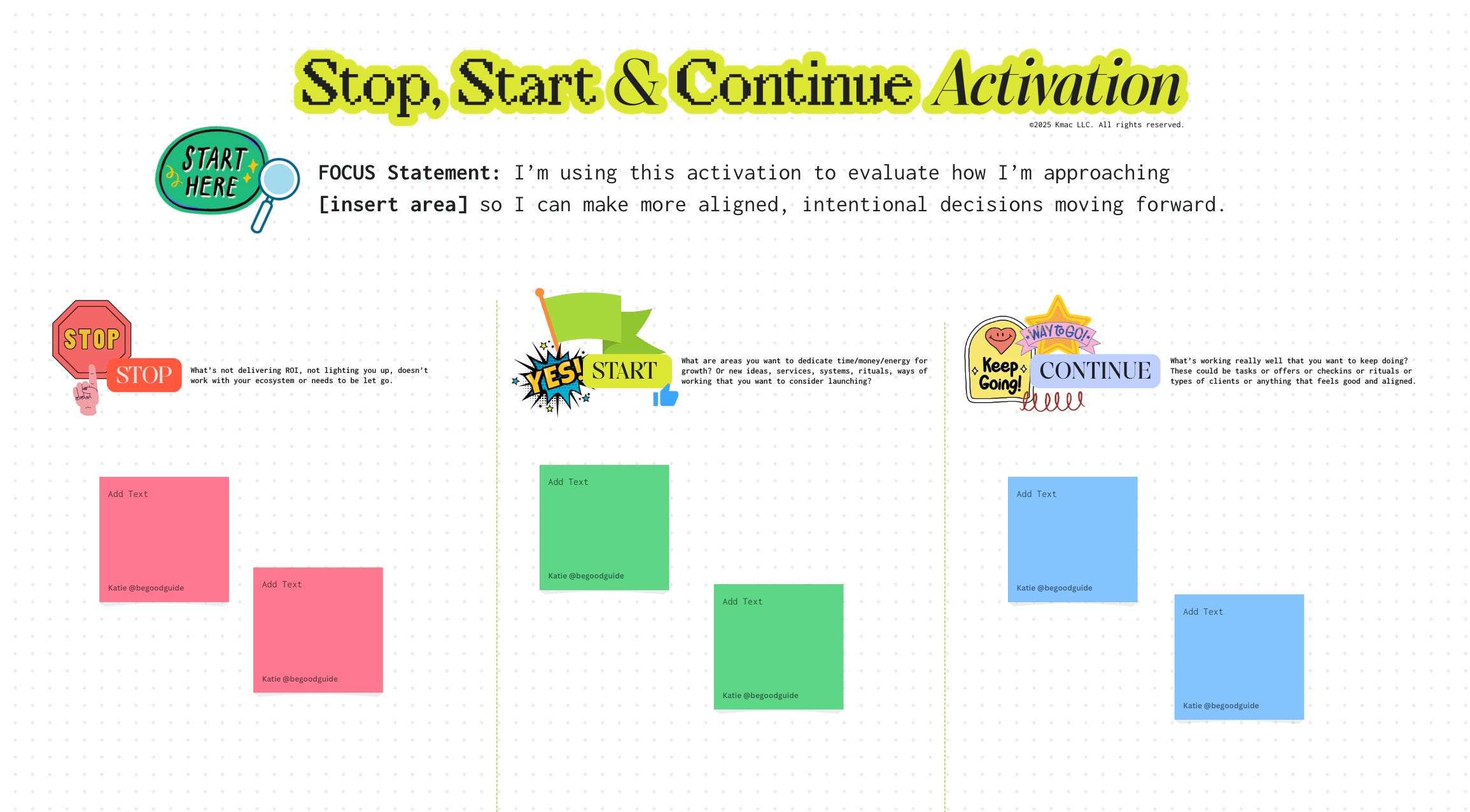
We split the board into three: what to stop, what to start, what to continue. What surfaced for me, watching this business from the outside, was a version of the exact thing I’d lived myself in January. One note I wrote during the retro: working on tasks that aren’t attached to a goal. Another: the business was mostly focusing on foundations, and it was time to shift into growth mode. Different business, same root cause. Motion without a ladder underneath it.
That’s the value of the retro. It surfaces where you’re moving for the sake of moving, before you build the next six months on top of it.
Two weeks out, the roadmap for that client is now built in structure, and we’re filling in the tasks as we go.
Start small
You don’t need a polished system to try this. Grab three columns, real or digital, and write down what to stop, start, and continue looking back on your last six months. Then take one goal you’re already circling and ask what the milestone underneath it actually is, not what you could build, but what specific, completable thing would move you toward it. Break that milestone into three tasks you could do this week.
I haven’t built the roadmap out as a template yet. I want to know what would actually be useful before I do.
Something else? Tell me in the comments, it’ll shape what I make next.
And if you’re already thinking “I don’t have time to build this myself,” I have one spot open right now for ongoing strategy and build support, the kind of thing where I’m in your business monthly helping you actually run this. Reply to this post if that’s you.

P.S. What’s one thing on your task list right now that isn’t attached to anything? Sit with that for a second.
